
What Are We Missing?
- 15 April 2026
Can the breath drive anxiety?
The Hidden Signs of Breathing Pattern Disorders Series.
Our recent newsletters have explored subtle clinical signs often overlooked.
Last time: Can chronic yawning or sighing be a sign of a Breathing Pattern Disorder?
→ Yes, it can.
Can anxiety be a sign of a Breathing Pattern Disorder?
We know from the literature that breathing retraining reduces anxiety. (Rajesh 2026,Sarini 2026, Permana 2026).
BradCliff suggests that not only does breathing well reduce anxiety, but it also alters the mechanism driving anxiety, which is known as dysfunctional breathing. Therefore, how we breathe doesn’t just reduce anxiety: it may be driving it.
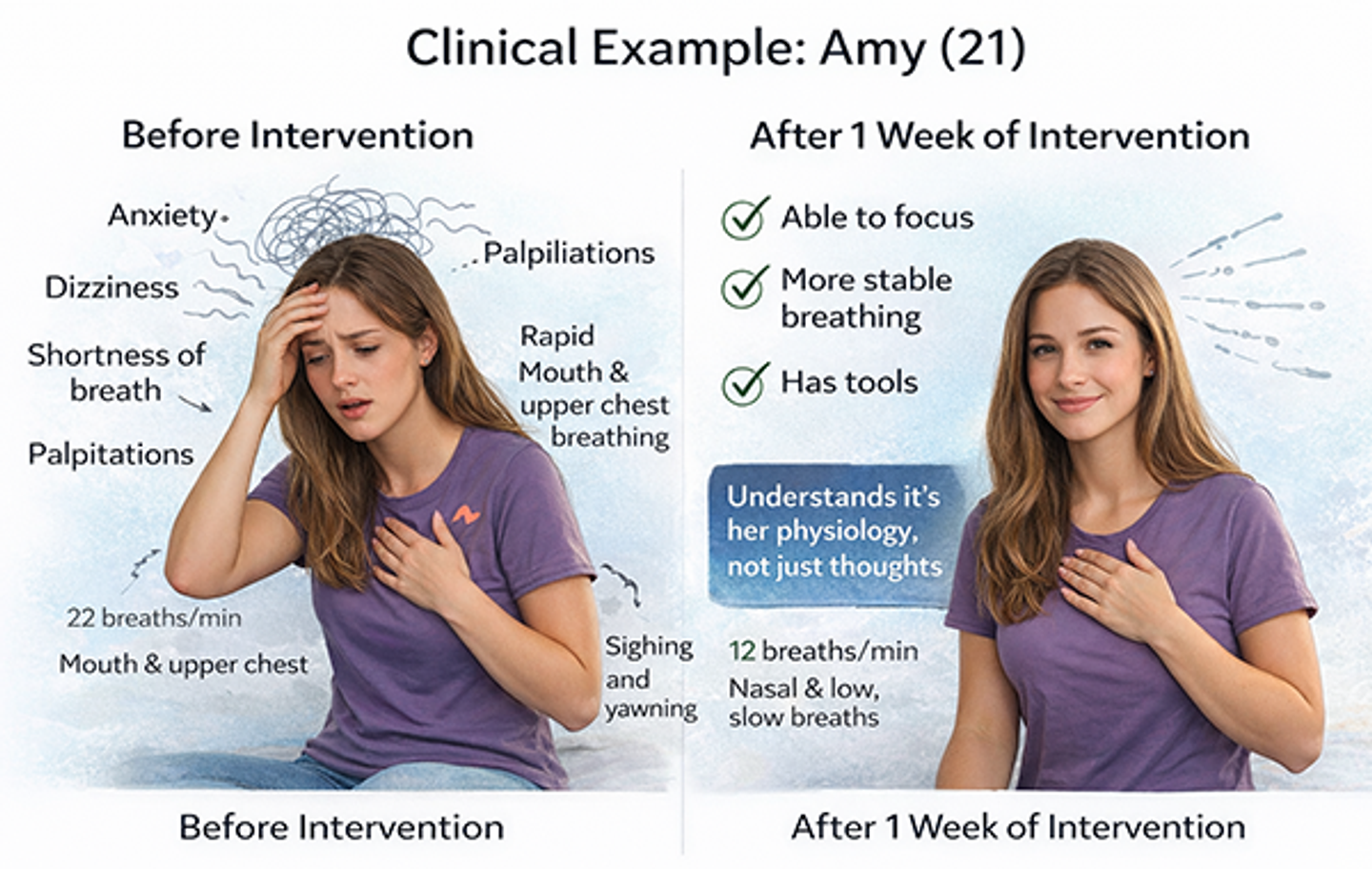
Amy (21) presents with a diagnosis of ‘anxiety’. On examination, her main symptoms are poor focus, dizzy spells, shortness of breath, heart palpitations, and feeling on edge.
Objectively, she presents with a resting respiratory rate (RR) of 22 breaths per minute; her breathing pattern is mouth- and upper-chest-dominant, and her speech is interspersed with sighs and yawns. NB She has been screened by her GP for any red flags or signs of something sinister. The way she feels makes her feel worse.
Breathing dysfunction perpetuates the vicious cycle. After x1 week of intervention, she feels she has control, she has tools to help alleviate her symptoms, she can focus, and her breathlessness has reduced. She understands it is NOT just her thoughts but her physiology that was driving the horrible sensations.
The Physiology
Evidence continues to emerge supporting that Breathing Pattern Disorders (BPD) can underpin symptoms often labelled as 'anxiety.'
Dysfunctional breathing can:
- Increase sympathetic drive → persistent state of alertness
- Reduce HRV (heart rate variability) → poor autonomic adaptability
- Lead to low CO₂ (hypocapnia) → altered brain and body function
What This Means
Anxiety is not always just psychological; it is often physiological.
Low CO₂ can alter cerebral blood flow, contributing to dizziness, brain fog, and distress. (Caldwell et al., 2021).
Reduced HRV reflects a system stuck in 'on' mode, with limited ability to recover. (Cheng et al., 2022).
Importantly, slow, controlled breathing has been shown to improve autonomic balance and reduce symptoms.(Laborde et al., 2022)
Dysfunctional breathing is commonly present in anxiety presentations, and targeted breathwork interventions can significantly reduce symptoms. (Banushi et al., 2023).
Why This Matters
Chronic dysregulated breathing may:
- Lower the threshold for dizziness or syncope
- Contribute to palpitations and rhythm instability
- Exacerbate autonomic imbalance
- Lead to a chronic stress loop
Patients often present with:
- 'Unexplained' anxiety
- Breathlessness
- Fatigue
- Light-headedness
The Bradcliff Perspective
Without addressing the breathing pattern, we may be overlooking the primary driver. Health starts with restoring baseline calm at rest. Breathing well allows this. For a healthy adult:
- Nasal
- Low and slow (10–14 breaths/min)
- Abdominal
- Regulated, not reactive
And most importantly:
At the end of the exhale, "the moment of nothing". This is where the system resets.
Final Thought
In a world that keeps us constantly 'on', the answer may not be doing more, but breathing well.
The breath is not simply a reflection of anxiety; it is often the mechanism driving it.
So remember:
When in doubt, breathe out.
And feel the moment of nothing.
References :
Banushi, B., Brendle, M., Ragnhildstveit, A., et al (2023). Breathwork interventions for adults with clinically diagnosed anxiety disorders: A scoping review. Brain Sciences, 13(2), 256.
Caldwell, H.G., Howe, C.A., Chalifoux, et al (2021). Arterial carbon dioxide and bicarbonate rather than pH regulate cerebral blood flow in the setting of acute experimental metabolic alkalosis. The Journal of Physiology, 599(5), pp.1439–1457.
Cheng, Y.-C., Su, M.-I., Liu, C.-W., Huang, et al (2022). Heart rate variability in patients with anxiety disorders: A systematic review and meta-analysis. Psychiatry and Clinical Neurosciences, 76(7), pp.292–302.
Laborde, S., Allen, M.S., Borges, et al (2022). Effects of voluntary slow breathing on heart rate and heart rate variability: A systematic review and a meta-analysis. Neuroscience & Biobehavioral Reviews, 138, 104711.
Permana, A., Rahmi, U. and Wahdini, R. (2026) Slow breathing and progressive muscle relaxation in pre-elderly individuals with hypertension. Journal Keperawatan Komprehensif, 12(1), pp. 66–75. → Combined intervention significantly reduced anxiety levels.
Rajesh, A.R., Sumaiya, S. and Kumar, A.K.V.K. (2026) Impact of structured breathing exercises for anxiety and procrastination among physiotherapy students. Indian Journal of Physical Therapy, 7(1), pp. 34–42. → Structured breathing significantly reduced anxiety over 28 days.
Sarini, S., Lismayanti, D., Rosmiyanti, Y. et al. (2026) The effectiveness of 5-finger hypnosis combined with deep breathing relaxation techniques. The Journal of Mother and Child Health Con