BradCliff in the UK
- 3 July 2026
A Journey of Collaboration, Learning and a Vision for the Future
Over the past few weeks, I have had the privilege of presenting in the UK and meeting with clinicians, researchers, educators and industry leaders who share a passion for advancing breathing assessment and rehabilitation.
From London workshops to presentations, clinical discussions and new collaborations. Each meeting and event added another piece to the puzzle. Presented here in the order they occurred, these experiences shaped my thinking about where BradCliff and breathing assessment more broadly are heading.
POWERbreathe International
One of the highlights of the trip was meeting with the team at POWERbreathe International Ltd, with whom we have had a relationship since they acquired the device in 2002. BradCliff believes respiratory muscle training is a powerful tool, but like any clinical intervention, it is most effective when guided by a comprehensive assessment and sound clinical reasoning.
BradCliff has always used Respiratory muscle training devices. The POWERbreathe device is our preferred choice for clinical practice, pioneered by research from sports scientists in the UK. It was invaluable to discuss with Harry Brar the process he underwent for the device's product development and to hear about the commitment and rigorous R&D behind the devices.
Harry Brar's relentless pursuit of excellence through research, innovation and meticulous product development has created one of the world's leading Respiratory muscle training systems.
Thank you, Harry Brar and the POWERbreathe team: Duncan, Sabrina Brar and Mary-Ann; your devices support our clinical practice by assisting in the assessment of Respiratory muscle function and helping provide targeted treatment protocols.
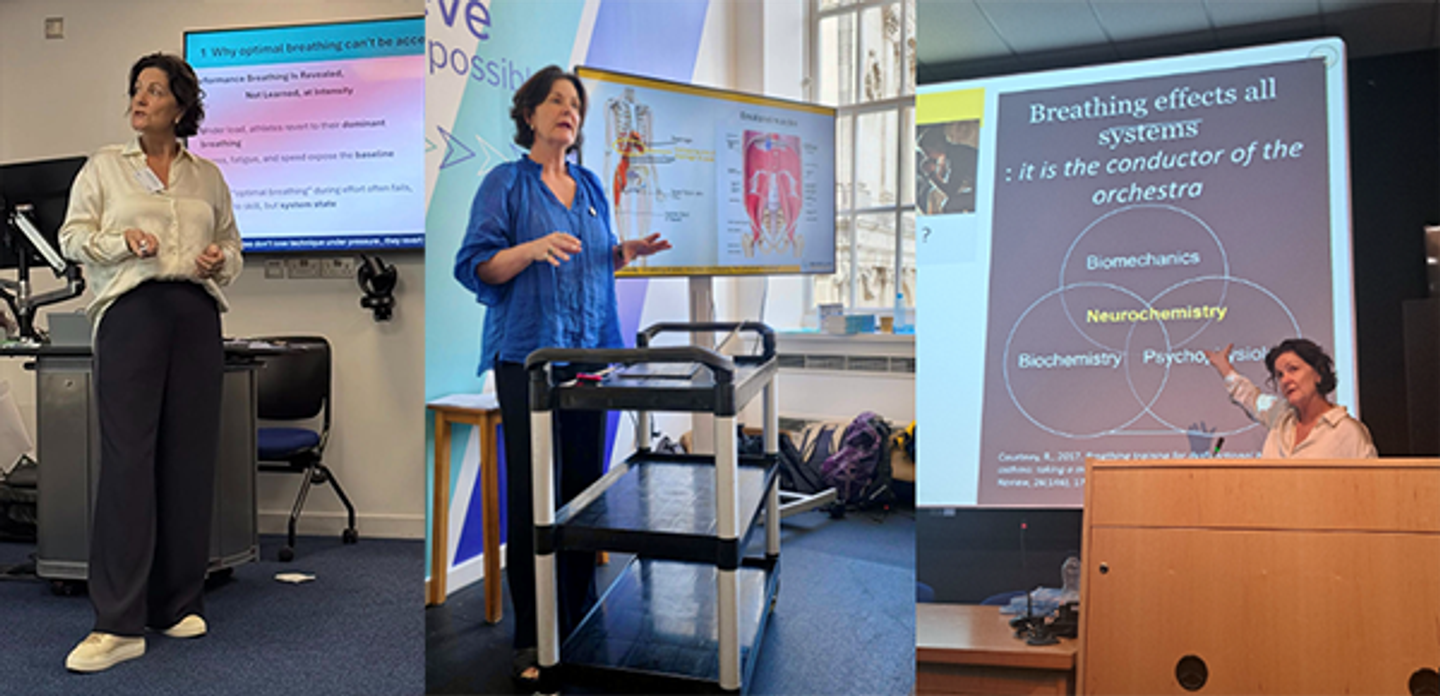
‘Breathing to Win’ workshop at the Institute of Sport, Exercise and Health (ISEH)
It was a privilege to present at the Breathing to Win workshop at the Institute of Sport, Exercise and Health in London. The workshop brought together health professionals working in elite sport and performance, all asking the same question:
How do we optimise breathing to improve performance in athletes?
My presentation message was simple:
- Breathing underpins performance.
- The way we breathe at rest influences movement, recovery, efficiency and performance.
- Before looking at strength, fitness, technique or introducing devices, we must first understand how the breathing system is functioning.
It was a privilege to present alongside Professor James Hull, whose internationally recognised work in sports and respiratory medicine has significantly advanced our understanding of breathing in athletes. I was also delighted to share the programme with BradCliff-trained clinicians Clare-Louise Chadwick, Julie Backley and Gwynn Wallace, as well as Dr Eric Harbour, PhD, ATC, whose current work in wearables is fascinating. Together, the programme showcased the strength of multidisciplinary collaboration and highlighted how breathing assessment and optimisation can support health, rehabilitation and performance across a wide range of clinical settings for the athlete.

BradCliff Workshop – A Truly International Experience
One of the most rewarding experiences was delivering a tailored BradCliff workshop attended by clinicians from nine different countries, bringing expertise from a wide range of disciplines.
I was humbled by the calibre of participants, and I am regretful I did not have more time with each individual participant.
Thank you to BradCliff Associates Pip and Samantha Holtzhausen, who shared the teaching and athletic loads the following day, running for BradCliff in the 12th annual Institute of Sport, Exercise and Health (ISEH) Run at Regents Park. Pip came 1st in the 5km for her age group, and Sam ran the full 5km, nasally breathing the full distance. (Well done also to Julie and Clare-Louise Chadwick).

Another thanks you to POWERbreathe international who gave each participant a IMT and EMT device.

To Neil Med International for providing each participant with a nasal rinse bottle.
But the biggest thanks go to Arlene Klue, who worked behind the scenes to co-ordinate and make the day happen. It is all in the detail, down to giving the caterers her favourite salad recipe for the event – anyone who goes to conferences and workshops knows it is all about the food – thanks, Arlene, we loved it.

We did have a discussion for an hour after the workshop, attempting to: Define and articulate the Role of Breathing-Focused Physiotherapy. Details of this will be shared separately.
CPD Hour – Breathing Pattern Disorders in Primary Care
It was also a pleasure to present a CPD session at St John & St Elizabeth Hospital on recognising and managing breathing pattern disorders in primary care. The record enrolment of over 500 practitioners reinforced my belief that breathing assessment is becoming recognised as a core clinical skill, not just a specialist interest. The session focused on practical assessment, clinical reasoning and multidisciplinary management—helping clinicians recognise breathing dysfunction earlier and make more informed treatment decisions. Thank you yet again to Arlene Klue and the team at St John's and St Elizabeth.
My key message: “breathing assessment should become as routine as blood pressure and temperature taking“.
Looking Beyond Respiratory Physiotherapy
A particularly valuable discussion was with Lizzie Grillo, where we explored the future of breathing rehabilitation.
The UK has developed an outstanding body of work through respiratory physiotherapy, particularly within the NHS. However, our conversations highlighted the need to broaden that perspective.
Breathing is relevant not only to respiratory disease, but also to athletes, musculoskeletal conditions, chronic pain, voice disorders, oncology, anxiety and many other clinical populations.
This reinforces Brad Cliff’s vision of creating an international multidisciplinary network where clinicians can learn from one another across specialities.
Royal Marsden Exercise Oncology Study Day
Presenting at the Royal Marsden was another highlight.
The programme demonstrated how exercise, rehabilitation and breathing optimisation can improve outcomes for people living with and beyond cancer.
It was inspiring to work alongside leading clinicians committed to evidence-based practice and multidisciplinary collaboration.
It was an honour to contribute to the program alongside an outstanding faculty, including Catherine Granger, Rebecca Robinson, Kerry Archer, Sarah Russell, Preksha Vivekanandan and Lucie Farrell.

Their presentations highlighted the power of multidisciplinary collaboration in improving outcomes for people living with and beyond cancer, at every age, every stage, and across the spectrum from sedentary to elite. A topic close to my heart.
I was delighted to share the role that breathing assessment and optimisation can play in supporting function, confidence, exercise tolerance, and quality of life.
What Did the UK Visit Teach Us?
The UK visit left me inspired. I met:
- Outstanding clinicians.
- Excellent educators.
- Innovative technologies and products.
- Specialists from many different disciplines.
Yet one observation stood out above all else:
There is still no common clinical framework that brings these strengths together.
That is where I believe BradCliff can contribute. BradCliff is not another breathing technique.
It is an integrated clinical framework for assessing, understanding and optimising breathing across the whole individual, linking physiology, biomechanics, neuroscience and clinical reasoning regardless of discipline or diagnosis.
Looking Ahead
As I return home, I am more convinced than ever that breathing deserves greater recognition in healthcare.
My hope is that one day every clinician will routinely ask:
"How is this person breathing?"
Just as naturally as we measure blood pressure, heart rate and temperature.
Because better breathing starts with better assessment.
'The Why Before the How.'
