
Your client’s breathing is telling you something
- 23 October 2026
Do you know what to look for?
At BradCliff, we spend most of our working lives watching people breathe, and we can tell you that, often long before a client finds the words for what’s going on, their breathing has already articulated it, if you know how to tune into it.
BradCliff has educated several thousand medical practitioners and delivered many keynote lectures at conferences of all kinds. Still, we always come back to a few tell-tale signs that someone’s baseline breathing pattern is off.
Three key things to observe
The minute a client walks in the door, every clinician starts observing, assessing, listening and looking. What we look for, primarily, are three key things:
- What is the respiratory rate at rest? A breathing rate that stays fast while a client is sitting quietly can be an early clue that something is off.
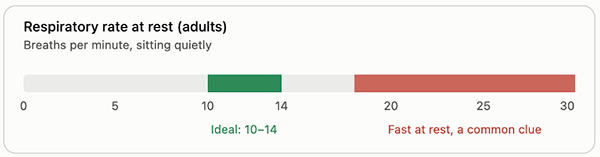
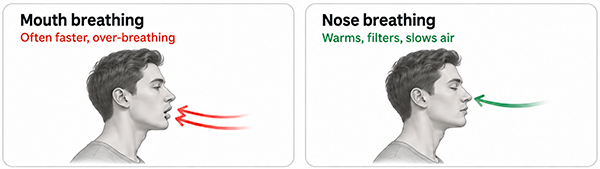
- Mouth or nose? Sitting quietly, most of us breathe gently through the nose. A client who breathes quickly and shallowly through the mouth at rest may be over-breathing without knowing it.
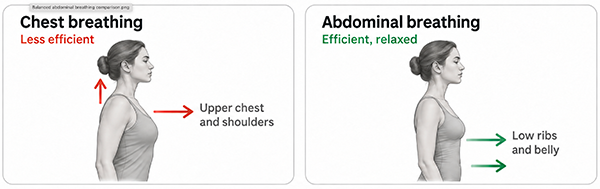
- Where does the breath begin at rest: chest or abdomen? Breathing apically, from the chest first and foremost, is a common sign. Watch the shoulders and upper chest rather than the belly. If the shoulders rise with each breath, and there’s very little movement low down around the ribs and abdomen, the breathing is working harder than it needs to.
Why does this matter?
When someone over-breathes, the body chemistry shifts, and that can bring on dizziness, tingling, chest tightness, a racing heart or a feeling of not getting enough air. For an anxious client, those sensations can feel like proof that something is terribly wrong, and round and round the panic loop goes. The good news is that breathing patterns can be retrained, and that can take a real weight off the work you’re already doing together.
You don’t need to become a breathing expert to make use of this. Simply noticing, and perhaps gently naming it (“I noticed you held your breath just then”), can open a whole new conversation. If you’d like something more structured, the Nijmegen Questionnaire is a simple, well-established screening tool, and a therapist qualified in breathing rehabilitation (find one here) can do the detailed assessment and retraining alongside your work.
References :
Bondarenko, J. et al. (2026) ‘Optimal treatment for dysfunctional breathing in adults: an international Delphi study’, Clinical & Experimental Allergy. Available at: https://doi.org/10.1111/cea.70247.
Clifton-Smith, T. and Rowley, J. (2011) ‘Breathing pattern disorders and physiotherapy’, Physical Therapy Reviews, 16(1), pp. 75–86.
https://www.aipro.info/drive/File/Breathing_pattern_disorders_and_physiotherapy_inspiration_for_our_profession.%20T.%20CliftonSmith,%20J.%20Rowley.pdfGrillo, L.J.F. et al. (2025) ‘Physiotherapy assessment of breathlessness and disordered patterns of breathing: defining a consensus on terminology and assessment’, Chronic Respiratory Disease, 22, 14799731251315483. Available at: https://doi.org/10.1177/14799731251315483.
Stewart, A., Ellis, R. and Mooney, S. (2026) ‘Physiotherapy management of adults with breathing pattern disorders: a scoping review’, Physical Therapy Reviews. Available at: https://doi.org/10.1080/10833196.2026.2668305.