
Mentors, Colleagues, Friends.. Trail Blazers
- 10 September 2026
Mentors, Colleagues, Friends.. Trail Blazers
Honouring Dinah Bradley (Morrison)
This week would have been Dinah's birthday and at the very same time I have finally taken on the epic, epic job of tidying my office. Predominantly paper: articles, notes, scribbles and clippings saved since the very beginning of Breathing Works and the BradCliff Breathing Method. You can do the maths on those dates.
This is BIG, and it has brought up many emotions. Firstly, remembering Dinah.
We met in1991. I had just returned from the UK, where I had been working in the field of hyperventilation syndrome, and I was now in the musculoskeletal outpatients department at Middlemore Hospital, Auckland N.Z. Dinah came in to give a presentation on her new book, Hyperventilation Syndrome. Please note, it is still in publication - WOW.
I remember, as she left, this overwhelming sensation that I simply had to talk to her. My head talked me out of it, and then my heart said, run after her; you have to talk to this woman. So I did. I ran down the corridor as fast as I could, out into the car park, and just caught her.
You have to remember that in 1991 contacting someone was not easy. In person was often the only way, so this was my chance.
I am so glad I took it. We gelled immediately and quickly formed a 'breathing' bond.
Before long we were both lecturing and speaking on hyperventilation syndrome together. I came from a musculoskeletal background and Dinah from a respiratory one; it turned out to be a perfect marriage for the breath — the scope of breathing, not respiration. That distinction mattered to us, and it is why we coined the term breathing pattern disorders early on in favour of hyperventilation syndrome.
We wrote books together, and that led to colleagues asking for workshops. We were published frequently in the media and appeared on all sorts of television clips. I do sometimes wonder what would have happened had social media existed back then — I suspect we would have gone international a good deal sooner, and a good deal bigger.
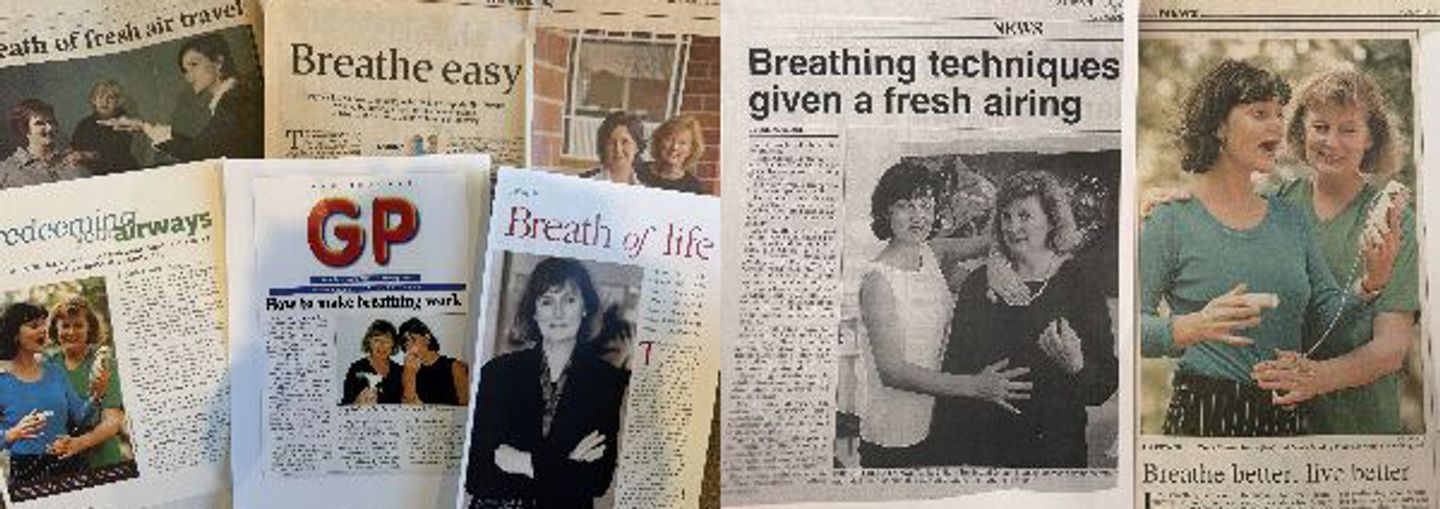
The people who paved the way
Information was not at your fingertips in those days — hence the copious amounts of paper I still have. Most articles were only digitised from the early 2000s. The only way to learn was to travel, and we spent a great deal of time at conferences abroad. All of my savings in my twenties went on conferences - nerdy, maybe, yes— but I was hungry to learn, and there was nowhere else to get it. Most of our learning was through the International Society for the Advancement of Respiratory Psychophysiology.
The gatherings were small, but they brought together enquiring minds, many of whom are the heavyweights of research in this field nowadays. What a privilege it was. Saint-Flour in France in 1994, Nijmegen in the Netherlands in 1996, Cape Cod in 1997, Perpignan in 1998, San Diego in 2000 and Oxford in 2001. Thank you to those I met who shared ideas, theories, and research with me over the years.
Nijmegen 1996

Saint-Flour, France, 1994 | Nijmegen, Netherlands, 1996
A note on the Nijmegen Questionnaire
It is worth knowing where our most-used tool actually came from, The original symptom list came out of Nijmegen itself, from Van Doorn, Colla and Folgering in 1982–83. It was Jan van Dixhoorn and Duivenvoorden who validated and refined it in 1985.
Recently validated for children and adolescents for the first time by Theofanidou-Axelsson and colleagues, they reshaped the wording for children. https://pubmed.ncbi.nlm.nih.gov/42563323/
Our own additions at BradCliff
If you use the BradCliff version of the questionnaire, you will notice a few things we have added.
https://www.scribd.com/document/750267965/Nijmegen-Questionnaire
- The bracketed descriptors are words we added to help clarify sensations. The original wording left room for varied and confusing interpretation.
- The numbered columns 1, 2 and 3, so the same form can carry three time points — column one at initial assessment, column two six weeks on, and column three at three months. It means you can see the shift at a glance rather than hunting through the file.
- The time frames in brackets in the scoring, added for consistency. Each symptom is scored as follows:
- 0 = Never
- 1 = Rare (monthly)
- 2 = Sometimes (weekly)
- 3 = Often (every other day)
- 4 = Very often (daily)
All of these additions were made in correspondence with Jan van Dixhoorn himself, with his approval. He had always intended to revise the original questionnaire but never got round to it, and we believe these changes allow for better accuracy of assessment.
San Diego in 2000
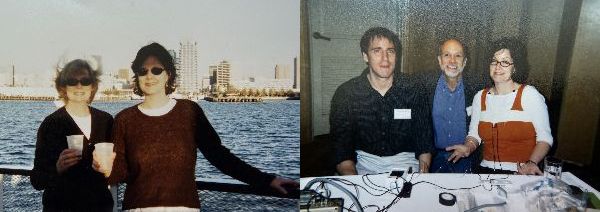
Not all work, and being wired up to measure my breathing pattern and heart rate, early respiratory inductive plethysmography, and my first taste of HRV.
Thank you to those who shared their ideas and their time so generously. I did not know I was being mentored at the time.
The ISARP group
Breathing retraining
The inspiring physician and true gentleman Claude Lum, a pioneer in making hyperventilation clinically treatable, along with Diana Innocenti, a British physiotherapist. Peter Nixon and Jenny King at Charing Cross, who talked on effort syndrome. Robert Fried in the United States, who put measurement into consultations and was a great New York tour guide to me. Chris Bass and William Gardner in the UK — Gardner's 1996 Chest paper on the pathophysiology of hyperventilation disorders is still the reference, and the work he and Bass did together through the 1980s laid the ground for it.
Does breathing retraining actually work?
Beverly Timmons and Ronald Ley, who were among the first to properly ask whether breathing retraining actually works.
Resonance frequency and heart rate variability pioneers
Richard Gevirtz, now Distinguished Professor of Clinical Psychology, was mapping the psychophysiology behind functional cardiac symptoms and out-of-the-blue panic. He also introduced me to classical piano and to my first clam bake. It was at that meeting that Richard, Paul Lehrer and the Vaschillos — Evgeny, an electromechanical engineer, and his wife Bronya — were collectively working on resonance frequency and baroreflex training, the foundations of HRV biofeedback as we now know it.
A note here. The Vaschillos' work showed that resonance frequency sits at around 0.1 Hz, roughly six breaths a minute — the rate at which heart rate oscillation reaches maximum amplitude. But note that this is individual to each person. The exact frequency varies between individuals, which is why the protocol involves finding someone's resonance frequency rather than handing everyone the same number. That is the bit most breathing apps get wrong.
Let's drop the term HVS
Hornsveld and Garssen, who broke the term open — they showed that the provocation test did not reliably reproduce symptoms, and argued that "hyperventilation syndrome" had become so misused that it should be abandoned.
What the body is doing, and what the person notices
The key point these researchers have shown is that people are poor witnesses to their own breathing. You cannot ask a person how they are breathing and expect a reliable answer.
Walton T. Roth, who has published extensively on the respiratory physiology of panic disorder — CO₂ challenge, the conditioning of respiratory distress, and the finding that it is breathing, rather than heart rate or skin conductance, that is distinctively unstable in panic. The patient experiences catastrophe rather than a respiratory event.
Frank Wilhelm, whose speciality is ambulatory monitoring — you can only see that gap if you can measure people in daily life rather than in a laboratory.
Alicia Meuret, who developed capnometry-assisted respiratory training (CART) — close the gap by feeding the measurement back, and the panic improves. The breathing change is what drives the improvement.
Thomas Ritz, who showed that the airway responds to emotion, not just to air.
Andrew Harver, for his key work in respiratory perception and asthma in children. In asthma, some children feel severe distress with minimal obstruction, and others feel nothing while badly obstructed. Perception and physiology come apart in both directions, which explains why you cannot treat the symptom alone or the measurement alone.
Lawrence Schleifer, who developed a hyperventilation theory of job stress and work-related musculoskeletal disorders. At a desk under pressure, people overbreathe without any awareness of it at all, and the bill arrives as neck and shoulder pain.
Other work noted
Mike Thomas, and his work in asthma and writing the foreword to our Dynamic Breathing for Asthma book.
Leon Chaitow, with Dinah and Christopher Gilbert, whose textbook Multidisciplinary Approaches to Breathing Pattern Disorders set the standard. Chris — many a road trip with you, and great chats on Zoom.
Rosalba Courtney, who introduced the multi-dimensional model — biochemical, biomechanical, psychophysiological — along with the MARM and the SEBQ. And Jan van Dixhoorn, on breathing and relaxation therapy.
Physiotherapy colleagues
Rik Gosselink, then presenting on breathing exercises in COPD, who later took respiratory physiotherapy into intensive care and into the guidelines — the muscle, the mechanics and the evidence.
Ann Pitman, whom I worked alongside at The Princess Grace for a stint in 1994, and who founded the UK clinical interest group in 1993 (physiotherapyforbpd.org.uk).
Julie Backley, who pulled the physiotherapy day together in Oxford in 2001 (I recently presented at the ISEH Learning: Breathing to Win course). That was the day I argued the physiotherapist's case alongside a chest physician and a psychiatrist.
Dave Nicholls asked whether physiotherapy's research was rigorous enough, and he went on to write the critical history of the entire profession. He is now Professor of Critical Physiotherapy at AUT.
On a side Note
And with big hearts, to our former staff and administrators, to the New Zealand medical teachers, mentors and supporters who backed us over the years, and to fellow clinicians, especially Janet Rowley. There are too many to name.
To also acknowledge Scott and Brooke Peirce, co-directors of Breathing Works and BradCliff Breathing, plus the associates and graduates at BradCliff who continue to lead this field.
A little nod to those who came before
Which brings me to the reason I wanted to write this.
Breathing is having its moment. There are more people in this space than ever before, and that is genuinely wonderful — anything that gets the world breathing better is a win in my book. But if you are newer to this work, I would gently encourage you to look back a little.
Almost nothing we teach today is new.
The terminology, the assessment, the retraining, the understanding that breathing sits at the crossroads of the musculoskeletal, the respiratory and the emotional — all of it was hard-won by people who did the work in small rooms, on paper, with no algorithm to amplify them.
Know whose shoulders you are standing on. Cite them, credit them, and honor your peers while they are still here to hear it. It costs nothing, and it means everything.
Dinah, thank you. For the corridor, the car park, the books, the travel, the arguments, the laughs, and the life's work.
I miss you.
Warmly, Tania
References :
ISARP Meeting Abstracts and Indexes
1996 Conference in Nijmegen
https://static1.squarespace.com/static/5a52b5c48a02c7e6580367cf/t/5a55549fc830255d57075445/1515541663748/1996_Abstracts_and_Index.pdf
1997 Conference in Cape Cod
https://static1.squarespace.com/static/5a52b5c48a02c7e6580367cf/t/5a555526e2c483d3bb9ce00b/1515541798174/1995_Abstracts_and_Index.pdf
2000 San Diego
https://static1.squarespace.com/static/5a52b5c48a02c7e6580367cf/t/5a5551ba652dea2491a41ea8/1515540924108/2000_Abstracts_and_Index.pdf
2001 London
https://static1.squarespace.com/static/5a52b5c48a02c7e6580367cf/t/5a554fda9140b7660bd49b07/1515540442943/2001+Abstracts_and_Index.pdf
Some excellent abstracts from currently prominent people: take time and read them.
Key references and Links: in order of mention
Lum, L. C. (1975). Hyperventilation: the tip and the iceberg. Journal of Psychosomatic Research
Innocenti, D. M. & Troup, F. (2008). Hyperventilation. In J. A. Pryor & S. A. Prasad (Eds.), Physiotherapy for Respiratory and Cardiac Problems, 4th edition. Edinburgh: Churchill Livingstone, pp. 529–549.
Rosen, S.D., King, J.C., Wilkinson, J.B. and Nixon, P.G.F. (1990) 'Is chronic fatigue syndrome synonymous with effort syndrome?', Journal of the Royal Society of Medicine, 83(12), pp. 761–764.
Gardner, W.N. (1990) 'Hyperventilation disorders', Journal of the Royal Society of Medicine, 83(12), pp. 755–757.
BOOK: Fried, R. (1993) The Psychology and Physiology of Breathing: In Behavioral Medicine, Clinical Psychology, and Psychiatry. New York: Plenum Press.— an excellent reference on breathing patterns, capnometry and the clinical psychophysiology of breathing: https://link.springer.com/book/10.1007/978-1-4899-1239-8
BOOK :Timmons, B.H. and Ley, R. (eds.) (1994) Behavioral and Psychological Approaches to Breathing Disorders. New York: Plenum Press
https://doi.org/10.1007/978-1-4757-9383-3
Vaschillo, E. G., Vaschillo, B. & Lehrer, P. M. (2006). Characteristics of resonance in heart rate variability stimulated by biofeedback. Applied Psychophysiology and Biofeedback, 31(2), 129–142.
https://pubmed.ncbi.nlm.nih.gov/16838124/
Lehrer, P. M. & Gevirtz, R. (2014). Heart rate variability biofeedback: how and why does it work? Frontiers in Psychology, 5:756.
https://pubmed.ncbi.nlm.nih.gov/25101026/
Dr. Richard Gevirtz's Journey from GSR to Heart Rate Variability (2025) Fred Shaffer
https://www.biosourcesoftware.com/post/dr-richard-gevirtz-s-journey-from-gsr-to-heart-rate-variability
Wilhelm, F.H., Trabert, W. and Roth, W.T. (2001) 'Physiologic instability in panic disorder and generalised anxiety disorder', Biological Psychiatry, 49(7), pp. 596–605.
Roth, W.T., Wilhelm, F.H., Pettit, D. and Meuret, A.E. (2005) 'Rescuing the hyperventilation theory of panic: reply to Ley (2005)', Psychological Bulletin, 131, pp. 199–201.
Meuret, A.E., Wilhelm, F.H., Ritz, T. and Roth, W.T. (2008) 'Feedback of end-tidal pCO2 as a therapeutic approach for panic disorder', Journal of Psychiatric Research, 42(7), pp. 560–568.
Schleifer, L.M., Ley, R. and Spalding, T.W. (2002) 'A hyperventilation theory of job stress and musculoskeletal disorders', American Journal of Industrial Medicine, 41(5), pp. 420–432.
Harver, A., Kotses, H., Ersek, J., Humphries, C.T., Ashe, W.S. and Black, H.R. (2013) 'Effects of feedback on the perception of inspiratory resistance in children with persistent asthma: a signal detection approach', Psychosomatic Medicine, 75(8), pp. 729–736. https://pmc.ncbi.nlm.nih.gov/articles/PMC4668923
Gosselink, R. et al. (2008) 'Physiotherapy for adult patients with critical illness: recommendations of the European Respiratory Society and European Society of Intensive Care Medicine Task Force on Physiotherapy for Critically Ill Patients', Intensive Care Medicine, 34(7), pp. 1188–1199.
Nicholls, D.A. (2017) The End of Physiotherapy. Abingdon: Routledge (Routledge Advances in Health and Social Policy). Publisher page: https://www.routledge.com/The-End-of-Physiotherapy/Nicholls/p/book/9780367224516
Clifton-Smith, T. and Rowley, J. (2011) 'Breathing pattern disorders and physiotherapy: inspiration for our profession', Physical Therapy Reviews, 16(1), pp. 75–86. Available at: https://doi.org/10.1179/1743288X10Y.0000000025
Chaitow, L., Bradley, D. and Gilbert, C. (2014) Recognizing and Treating Breathing Disorders: A Multidisciplinary Approach. 2nd edn. Edinburgh: Churchill Livingstone Elsevier. Link: https://www.us.elsevierhealth.com/recognizing-and-treating-breathing-disorders-9780702049804.html
New edition about to be released: later in 2026/2027
Chaitow, S., Clifton-Smith, T., Courtney, R. and Gilbert, C. (in press) Chaitow's breathing pattern disorders: a multidisciplinary guide to diagnosis, treatment, and management. 3rd edn. Edinburgh: Elsevier.